
Best Churches in Copenhagen: Top 10 Most Stunning, Ranked
Copenhagen has 10 historically significant churches genuinely worth a visit, and I've dragged countless friends through them, including the ones who swore "I don't really do churches." I'm Felipe, a Copenhagen local guide, and these buildings have taken my breath away more times than I can count: baroque spirals that make you dizzy, an expressionist brick cathedral that looks like it's from another planet, and some of the best free views in the city. Here's my honest, ranked list, with real hours and prices.
1. Why Copenhagen's churches are worth your time
Copenhagen isn't just colourful Nyhavn houses and the Little Mermaid, the real magic happens when you step inside buildings that have witnessed centuries of Danish history, several of which rank among the city's most important heritage sites and monuments. Whether you're religious or not, these places will move you: baroque spirals, expressionist brick, Russian Orthodox onion domes and a medieval survivor from 1296, all within a genuinely walkable area.
What makes Copenhagen's churches special is the variety, and the fact that almost all of them are free to enter, a real blessing in an expensive city. I've ranked the ten below on architectural significance, the quality of the visitor experience, and how much each one rewards the climb (literal or otherwise).
The Ranking
2. The 10 best churches in Copenhagen, ranked
Tap a name to open it directly in Google Maps.
Vor Frelsers Kirke (Church of Our Saviour)
That golden external spiral staircase, and the best view in the city at the topThe baroque interior dates to 1695, but everyone comes for the spire: 400 steps wind up around the tower, with the final 150 climbing the outside of the spiral, open to the wind, roughly 90 metres above Christianshavn. The carillon's 48 bells play through the day, and the church survived Copenhagen's devastating historic fires, so the carved oak altarpiece (1661) and pulpit (1662) inside are genuinely authentic 17th-century craftsmanship.
- Address: Sankt Annæ Gade 29, Christianshavn
- Hours: Daily 9:00-20:00 (tower closes earlier, and shuts entirely mid-December to late February)
- Cost: Church free; tower 50 DKK (May-Sept) or 35 DKK (Oct-Apr)
- Nearest station: Christianshavn Metro
- Open Vor Frelsers Kirke in Google Maps
- Official website
Tip: Book your tower time slot online in advance, it sells out in summer, and the tower closes temporarily in rain, snow or strong wind. Skip it entirely if you have vertigo, the last stretch is genuinely narrow and exposed.
Marmorkirken (Frederik's Church, the Marble Church)
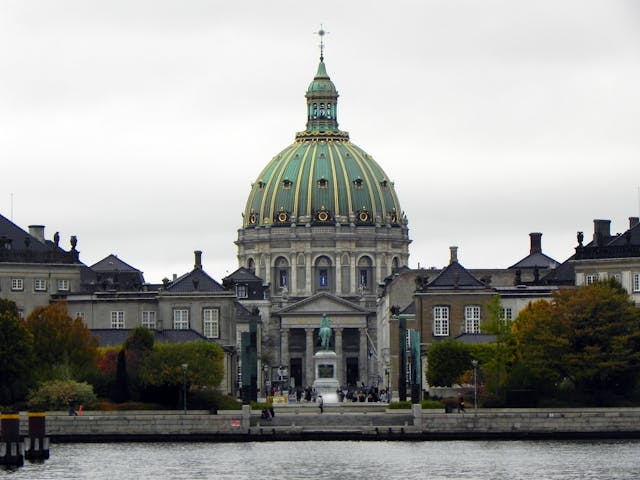
Scandinavia's largest dome, aligned in a straight axis with Amalienborg and the Opera HouseThe green copper dome spans 31 metres and looks like St Peter's Basilica had a baby with Danish restraint. Construction started in 1749, then stalled for over 120 years when the money ran out, the half-built shell sat as a gorgeous ruin until a wealthy financier funded its completion in 1894. Inside, light floods through tall windows onto paintings of the twelve apostles ringing the dome; outside, statues of Danish church figures, including Kierkegaard, line the exterior.
- Address: Frederiksgade 4, near Amalienborg Palace
- Hours: Mon-Sat 10:00-17:00 (Fri from 12:00), Sun 13:00-17:00
- Cost: Church free; dome tour around 50 DKK adults, 20 DKK children, daily in summer, weekends only in winter
- Nearest station: Marmorkirken Metro (M3/M4)
- Open Marmorkirken in Google Maps
- Official website
Tip: Visit Amalienborg right across the street afterward, the two sit on the same "Marble Axis" sightline toward the harbour and Opera House, one of the city's most impressive urban vistas.
Copenhagen Cathedral (Vor Frue Kirke)
Denmark's national cathedral, home to Thorvaldsen's original Christ statueAfter the British Navy destroyed the previous church in the 1807 bombardment of Copenhagen, architect C.F. Hansen rebuilt it in austere neoclassical style between 1810 and 1829. Bertel Thorvaldsen's marble statue of Christ with open arms, the original, later copied in churches worldwide, dominates the altar, flanked by his statues of the twelve apostles along the nave. Hans Christian Andersen's funeral (1875) and Crown Prince Frederik's wedding to Mary Donaldson (2004) both took place here.
- Address: Nørregade 8, near Indre By
- Hours: Mon-Sat 8:00-17:00, Sun 12:00-17:00
- Cost: Free (donations welcome)
- Nearest station: Nørreport
- Open Copenhagen Cathedral in Google Maps
- Official website
Tip: Free organ concerts run most Saturdays around noon. If you love Thorvaldsen's work, his dedicated museum on Slotsholmen, covered in my museums guide, is a natural next stop.
Grundtvig's Church (Grundtvigs Kirke)
Six million yellow bricks shaped like a Gothic cathedral crossed with a pipe organNothing else in Copenhagen looks like this. Architect P.V. Jensen-Klint's expressionist design, built 1921-1940 to honour priest and hymn writer N.F.S. Grundtvig, rises 49 metres in stepped yellow brick that reads as pure Gothic organ pipe from the street. Inside, plain glass windows and unadorned brick let the proportions do all the talking; the church seats 1,440 and its 1965 Marcussen organ has 4,052 pipes. Jensen-Klint died before completion, his son Kaare, later famous for his own furniture designs, finished the job.
- Address: På Bjerget 14B, Bispebjerg
- Hours: Mon-Sat 9:00-16:00 (Thu until 18:00), Sun 12:00-16:00 (13:00 in winter)
- Cost: Free
- Getting there: Bus 6A from Nørreport, alight at Bispebjerg Torv
- Open Grundtvig's Church in Google Maps
- Official website
Tip: Combine with Bispebjerg Cemetery's cherry blossom avenue in spring, and grab coffee afterward in Nørrebro, a short walk away. Morning light is best for photos of the brick facade.
St. Alban's Church (The English Church)
English Gothic Revival flint, funded partly by a Danish-born British queenPrincess Alexandra of Denmark, who became Queen Consort of the UK, helped fund this church for Copenhagen's English community in the 1880s. Architect Arthur Blomfield's Gothic Revival design uses flint, common in England but rare in Denmark, giving it a distinctly transplanted character right beside Østerbro's green edge. Fifteen tubular bells chime automatically every quarter hour across the surrounding park, and the setting, right by Kastellet and the Gefion Fountain, is one of the most peaceful in the city.
- Address: Churchillparken 11
- Hours (Apr-Sept): Mon-Sat 10:00-13:00, Sun 13:00-16:00
- Cost: Free
- Nearest station: Østerport
- Open St. Alban's Church in Google Maps
- Official website
Tip: Services run in English, part of the Church of England's Diocese in Europe. Combine easily with a walk through Kastellet, part of my heritage sites and monuments guide, and the Gefion Fountain next door.
Christian's Church (Christians Kirke)
The "Theatre Church," with rococo galleries rising three storeys on three sidesLocals call it the Theatre Church for good reason: Nicolai Eigtved's 1759 rococo design places tiered galleries around three sides of the room, so it genuinely resembles an 18th-century playhouse from the inside. Originally built for Christianshavn's German community, the altarpiece stacks a pulpit and organ vertically above it in an unusual "integrated altarpiece" layout. The Dalai Lama has spoken here, and the crypt holds 46 burial chapels still in occasional use.
- Address: Strandgade 1, Christianshavn
- Hours: Vary by season, check the church's current schedule
- Cost: Free
- Nearest station: Christianshavn Metro
- Open Christian's Church in Google Maps
- Official website
Tip: Check for concerts, the theatre-style acoustics make this one of the best chamber-music venues in the city. It's a short walk from Freetown Christiania if you want to combine the two.
Alexander Nevsky Church
Denmark's only Russian Orthodox church, three golden onion domes, a gift from a TsarBuilt 1881-1883 as a gift from Tsar Alexander III to his Danish-born wife Princess Dagmar, this is Copenhagen's one piece of 17th-century Muscovite architecture, and it stands out instantly among the city's Scandinavian rooflines. Red-and-grey brick with sandstone trim leads up to the three gleaming domes; inside, mosaics, icons and a mosaic floor create a genuinely different atmosphere from anywhere else on this list, especially when six synchronised bells chime through the day.
- Address: Bredgade 53, a few metres from Marmorkirken
- Hours: Very limited, roughly Fri 17:00-18:00, Sat 09:30-12:00 and 16:30-19:30, Sun 09:30-13:00, check before visiting
- Cost: Free (donations appreciated)
- Nearest station: Marmorkirken Metro
- Open Alexander Nevsky Church in Google Maps
Tip: Hours are genuinely limited, plan around them rather than dropping by on a whim. Pair it with Marmorkirken and Amalienborg for one dense cluster of sights on Bredgade.
Holmen's Church (Holmens Kirke)
A former anchor forge turned royal naval church, in continuous use since 1619Originally an anchor forge from 1563, King Christian IV converted the building into a naval church in 1619, and it has stayed tied to the Danish navy ever since. It's one of the few buildings to survive both of Copenhagen's great fires (1728 and 1795) and the bombardments of 1658 and 1807, so its Dutch Renaissance interior, oak altarpiece and pulpit both from the 1660s, is genuinely 17th century. Queen Margrethe II was baptised, married and had her children baptised here, and naval heroes Niels Juel and Peter Tordenskjold are buried in its chapel.
- Address: Holmens Kanal 21, near Christiansborg Palace
- Hours: Mon/Wed/Fri/Sat 10:00-16:00, Tue/Thu 10:00-15:30, Sun and holidays 12:00-16:00
- Cost: Free
- Nearest station: Kongens Nytorv
- Open Holmen's Church in Google Maps
- Official website
Tip: Look up for the votive model ship hanging from the ceiling, a Copenhagen naval-church tradition. It's usually quieter than the more tourist-heavy churches on this list.
Church of the Holy Spirit (Helligåndskirken)
Copenhagen's oldest surviving medieval building, dating back to 1296Founded in 1296 as part of a hospital, this is the oldest structure still standing in Copenhagen, and walking in halfway down Strøget feels like stepping out of the shopping street and back seven centuries. The main building was destroyed in the 1728 fire, but what survived, plus a bell tower reconstructed in 1880 and a Renaissance portal from 1630 bearing Christian IV's monogram, still carries real medieval weight. Regular concerts, including free Christmas performances, keep it a living part of the neighbourhood rather than a relic.
- Address: Niels Hemmingsens Gade 5, midway along Strøget
- Hours: Mon-Fri 12:00-16:00, Sat 11:00-13:00, Sun open only during service
- Cost: Free
- Nearest station: Nørreport or Kongens Nytorv
- Open Helligåndskirken in Google Maps
- Official website
Tip: A genuinely good shopping break on Strøget, and worth checking the events calendar for free concerts if you're visiting around the holidays or during Copenhagen's festival season.
Trinitatis Church
Part of Christian IV's astronomy-and-worship complex, attached to the Round TowerTrinitatis Church anchors the same 1637-1656 complex as the Round Tower next door, King Christian IV's ambitious combination of church, university library and astronomical observatory under one roof. The baroque interior's Italian-style organ and carved wooden ceiling are genuinely worth the visit on their own, and a glass viewing window inside the Round Tower's spiral ramp lets you look down into the nave without a separate ticket, a detail most visitors climbing the tower miss entirely.
- Address: Købmagergade 52, part of the Rundetårn complex
- Hours: Often closed outside services, but viewable from the Round Tower's window; check the church's own schedule for public opening times
- Cost: Free to view from the Round Tower window; the tower itself charges around 60 DKK
- Nearest station: Nørreport
- Open Trinitatis Church in Google Maps
- Official website
Tip: Combine with climbing the Round Tower itself, its spiral ramp instead of stairs is one of the easiest viewpoints in the city, full details in my heritage sites and monuments guide.
Quick Reference
3. At-a-glance comparison
A fast way to decide what fits your day.
| Church | Location | Entry | Extra cost |
|---|---|---|---|
| Vor Frelsers Kirke (Church of Our Saviour) | Christianshavn | Free | Tower: 35-50 DKK |
| Marmorkirken (Marble Church) | Bredgade | Free | Dome: ~50 DKK |
| Copenhagen Cathedral (Vor Frue Kirke) | Near Strøget | Free | Free |
| Grundtvig's Church | Bispebjerg | Free | Free |
| St. Alban's Church | Churchillparken | Free | Free |
| Christian's Church | Christianshavn | Free | Free |
| Alexander Nevsky Church | Bredgade | Free | Free |
| Holmen's Church | Slotsholmen area | Free | Free |
| Church of the Holy Spirit | Strøget | Free | Free |
| Trinitatis Church | Rundetårn complex | Free | Round Tower: ~40 DKK |
Plan Your Route
4. Best church-hopping routes
Group these by neighbourhood rather than chasing them in ranking order, it saves a lot of walking.
Morning: Old Town classics
Start at Copenhagen Cathedral, walk to Trinitatis Church and the Round Tower, then continue to the Church of the Holy Spirit on Strøget, all within 10-15 minutes of each other.
Afternoon: the Bredgade cluster
Marmorkirken, Alexander Nevsky Church (right next door) and St. Alban's Church, then a walk through Kastellet to finish.
Christianshavn route
Vor Frelsers Kirke and Christian's Church sit a few minutes apart, and Holmen's Church is an easy add-on across the water toward Slotsholmen.
Special half-day trip
Grundtvig's Church sits further out in Bispebjerg; budget 2-3 hours including travel, and pair it with coffee in nearby Nørrebro.
5. Practical tips before you go
Money-saving basics
Every church on this list is free to enter, you only pay for tower and dome climbs. The Copenhagen Card covers Vor Frelsers Kirke's tower for free, and combining several churches in one neighbourhood cuts down on transport costs.
Best time to visit
Summer (June-August) gives the longest hours but the biggest crowds. Spring and autumn are quieter with pleasant weather. Winter brings a magical Christmas atmosphere and free concerts, perfect for embracing Danish hygge, though Vor Frelsers Kirke's tower closes mid-December to late February and several churches run shorter hours.
Dress code and etiquette
Danish churches are relaxed, but modest attire (covered shoulders and knees) is appreciated. Photography is generally fine outside of services; skip flash and be mindful of anyone praying.
Weather considerations
Vor Frelsers Kirke's tower closes temporarily in rain, snow or strong wind, check the forecast before planning a climb, and always have a backup indoor stop ready given Copenhagen's changeable weather.
FAQ
6. Copenhagen churches: frequently asked questions
The questions I get asked most often about this topic.
Vor Frelsers Kirke (Church of Our Saviour) is the most-visited, famous for its external golden spiral staircase. Marmorkirken (the Marble Church) has Scandinavia's largest dome and is the most architecturally grand, while Grundtvig's Church is the most visually unique, built from six million yellow bricks in an expressionist style found nowhere else.
Yes, entry to every church on this list is free. Only tower and dome climbs charge a fee: Vor Frelsers Kirke's tower costs 35-50 DKK depending on season, and Marmorkirken's dome tour costs around 50 DKK for adults.
Vor Frelsers Kirke's tower, roughly 90 metres up via 400 steps with the final stretch outside the spire, offers the best panoramic view among the city's churches, looking directly across Christianshavn and the harbour.
Denmark's state church is Evangelical Lutheran, so most churches on this list, including all ten ranked here, are Lutheran or, in Alexander Nevsky's case, Russian Orthodox. Copenhagen does have small Catholic parishes, most notably Sankt Ansgars Kirke near the city centre, though they aren't architecturally comparable to the sites ranked here.
The Church of the Holy Spirit (Helligåndskirken) on Strøget dates back to 1296, making its surviving portions the oldest church building in the city, and one of the very few medieval structures left in Copenhagen at all.
Two to four is realistic if you group them by neighbourhood, the Old Town cluster (Cathedral, Trinitatis, Round Tower, Holy Spirit) or the Bredgade cluster (Marmorkirken, Alexander Nevsky, St. Alban's) each fit comfortably into a morning or afternoon.
My Local Take
7. Final thoughts: my take
If you only remember one thing from this guide, make it this.
If you only visit one, make it Vor Frelsers Kirke, the spiral climb is a genuine Copenhagen rite of passage and the view at the top justifies every one of the 400 steps. Add Marmorkirken next for the grandest interior, and Grundtvig's Church if you have half a day to spare and want to see something you won't find described accurately in any photo beforehand.
You don't need to be religious to feel something in these spaces. Architecture, history and human ambition come together here in ways that transcend belief, and Copenhagen's churches have survived fires, bombardments and the plain passage of time to keep telling that story. Pick one to start with, and I promise you'll want to see the rest.
Join the conversation
Comments
Questions, tips or corrections about this guide? Leave a comment, every comment is checked before it goes live.
Be the first to comment on this guide.
Thanks for your comment!
It's in the queue for review and will appear here once it's approved.