
Copenhagen Public Transport Prices 2026: Metro, Bus, Tickets & City Pass
A single Copenhagen metro ticket costs from 24 DKK, and a 24-hour City Pass from 100 DKK, covering the metro, S-train, buses and harbour buses on one ticket. I'm Felipe, a local guide who rides this network most days: here's exactly what every option costs in 2026, which one genuinely deserves your money, and the mistakes that trip up almost every visitor.
1. How Copenhagen's transport network fits together
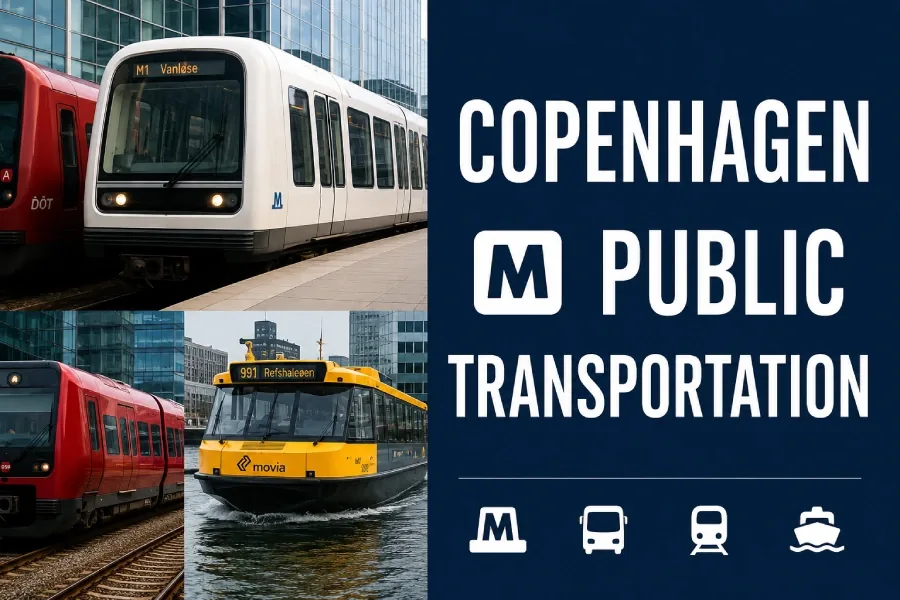
Copenhagen runs on one integrated ticket across six different ways of moving: the driverless metro, the S-train suburban rail, city buses, the harbour bus, the new light rail, and regional trains for trips further out. Buy or tap once, and it works across all of them within your zones and time window, so you don't need to think about which company runs which line.
Most of what a first-time visitor wants to see (Nyhavn, Strøget, Christiansborg, Amalienborg, the old town) sits comfortably within walking distance of itself, and honestly, the best way to get to know those streets is still on foot with someone who can point out what you'd otherwise walk straight past. That's the whole idea behind my private walking tour. Public transport is what you'll use to get there from the airport or your hotel, to reach the beaches and suburbs the metro doesn't cover, and to move fast between neighbourhoods once you've seen the centre.
This guide covers all of it: current 2026 prices, an honest ranking of which option is actually worth your time, exact frequencies, and the stations you'll use most. It's part of my complete Copenhagen guide, updated as the network changes, not written once and forgotten.
The Copenhagen transport map, and the only part of it you need
Every visitor looks for a Copenhagen transport map and then discovers there isn't one map, there are three: a metro line map, an S-train map and a fare zone map. Only the last one changes what you pay, and it is the one nobody shows you.
Fares here are not calculated by distance or by which line you take. The city is drawn as a set of concentric zones, and your ticket costs whatever number of zones you cross, on any combination of metro, bus, S-train and harbour bus. The centre is zones 1 and 2, and the airport is zone 4, which is the single fact that decides most visitors' first purchase.
For the actual line maps and live departures, the official sources are better than any copy: the official journey planner for door-to-door routes, Rejseplanen for live departures, and the metro operator for the metro network and ticket machines. What they do not explain well is the zone logic above, which is why it is here.
- Zones 1-2, the whole city centre: 24 DKK
- Zone 3, one step out: around 30 DKK
- Zone 4 and beyond: up to 60 DKK
- Airport to the centre crosses 3 zones, so around 30 DKK
- City Pass Small covers zones 1-4 including the airport, from 100 DKK / 24h.
City Pass Large covers zones 1-99, from 200 DKK / 24h.
The Ranking
2. The best ways to get around Copenhagen, ranked
Based on how each mode actually performs for a visitor (frequency, coverage, reliability and what riders and reviewers consistently say), not just which one sounds nicest on paper.
Metro (M1–M4)
Best all-round choiceFully automated and driverless, the metro is the backbone of the system and the only part that runs a genuine 24/7 schedule, every day of the year. It's also the fastest way to reach Kastrup from downtown, and the easiest option if you're travelling with a wheelchair, a heavy suitcase or a stroller: every station has lifts and level boarding.
S-train (S-tog)
Best for beaches, suburbs and day tripsThe red suburban trains reach places the metro doesn't: the harbour baths at Islands Brygge (one of the city's top free experiences), the beaches north of town, and the stations you'll use for day trips to Roskilde or Helsingør. Bikes ride free, and on Friday and Saturday nights it runs till dawn.
Harbour bus (991 / 992 / 993)
The prettiest way to cross townRegular public buses that happen to be boats, sailing the same harbour my private walking tour walks alongside. Line 991 heads south, 992 north, and a newer 993 shuttle runs a tighter loop between Nyhavn and Refshaleøen for the Reffen food-market crowd. Same ticket as any bus. The only real catch is capacity: the boats seat around 80 people and the main lines sail roughly once an hour, so this isn't the one to rely on if you're in a rush.
A-buses & 5C Cityline
Round-the-clock coverageWhen a direct surface route beats a transfer, or your hotel isn't near a metro or S-train stop, Copenhagen's bus network fills the gap: dense, frequent, and genuinely running 24 hours on core routes like the 5C between the airport and the northwestern suburbs. Traffic can slow it down at rush hour, which is the only reason it isn't higher on this list.
Greater Copenhagen Light Rail (Letbanen)
Newest, and improving fastA ring line linking the suburbs west and northwest of the city, bypassing downtown entirely. It's genuinely useful if you're staying near Ishøj, Glostrup or Rødovre, less so if you're based in the historic centre. Only the southern half is running today; the northern stretch to Lyngby and Lundtofte (17 more stations) is in final testing and expected to open by the end of August 2026, which will complete the full ring.
Honourable mention: regional trains (DSB and Öresundståg) aren't part of daily sightseeing, but they're what you'll use for day trips beyond the city, from Roskilde to Malmö across the bridge.
3. Tickets and prices in 2026
Copenhagen's zone system looks intimidating on a map and is actually simple in practice, because the Rejsebillet app calculates your zones for you: you just tell it where you're starting and ending.
Single tickets
A single ticket covers metro, bus, S-train, regional trains and the harbour bus interchangeably: buy once and transfer freely for up to an hour (longer on longer trips). Central Copenhagen sits within zones 1–2, and the airport is zone 4, three zones out from downtown.
| Zones | Typical use | Adult price |
|---|---|---|
| 2 zones | Most trips within the city centre | 24 DKK |
| 3 zones | City centre ↔ airport | ~30 DKK |
| Up to 8 zones | Reaching further into North Zealand | Up to 60 DKK |
Children aged 12–15 pay half price; under-12s travel free with a paying adult (up to two per adult).
City Pass: the best option for most visitors
If you'll take more than 3–4 rides in a day, the official City Pass beats buying singles. It gives unlimited travel for a set number of hours, from 24 up to 120, with no need to check in or out.
- City Pass Small (zones 1–4, the city plus the airport): 100 DKK for 24 hours, around 270 DKK for 72 hours, up to 340 DKK for the full 120 hours (48- and 96-hour options are priced in between). Children pay roughly half.
- City Pass Large (zones 1–99, the whole capital region including North Zealand): 200 DKK for 24 hours, up to 680 DKK for 120 hours.
For a typical 3–4 day trip based in the centre with one airport transfer, City Pass Small comfortably covers everything. If you're also planning day trips into North Zealand (Kronborg Castle, the Louisiana Museum, Roskilde), go with City Pass Large instead.
What about a monthly pass?
Copenhageners commuting daily use a Pendlerkort, a period pass priced by zone rather than by hours, set up through the Rejsekort app. It's built for residents, not visitors: its minimum period is 30 days, so even a full week in the city works out cheaper on City Pass Large than on a Pendlerkort. If you're relocating to Copenhagen rather than visiting, that's the one to ask about at any staffed station.
How to actually buy a ticket in 2026
The DOT Billetter app most guides still mention closed at the end of 2025. It's been replaced by Rejsebillet (iOS and Android), which now handles single tickets and City Passes, with an English interface and card payment built in. Ticket machines at every metro and train station, including the airport, still sell the same tickets and accept cards.
The physical Rejsekort is being retired
If you're following older advice that recommends buying a plastic Rejsekort card at the airport, don't: it's being phased out through 2026 and can no longer be used to travel. For pay-as-you-go pricing that automatically works out your zones, use the Rejsekort app instead, which does the same job on your phone.
What about the Copenhagen Card?
The Copenhagen Card is a different product: alongside unlimited public transport, it also includes free entry to 80+ attractions (Tivoli, Rosenborg Castle, Christiansborg, the Round Tower and more). A 24-hour adult card runs around 479 DKK, dropping sharply per day the longer you buy it. It only pays for itself if you're planning to hit several paid attractions on the days you're using it; for transport alone, a City Pass is cheaper. See whether it's worth it for your trip in my Copenhagen travel FAQ.
4. Frequencies, hours and journey times
Metro (M1–M4)
Expect a train every 2–4 minutes at rush hour, 4–6 minutes for most of the day, and 15–20 minutes overnight (down to 7–15 minutes on Friday and Saturday nights). From the airport, it's roughly 15 minutes to Nørreport or Kongens Nytorv.
S-train (S-tog)
Trains run from around 05:00 to 00:30 on weekdays, with all-night service on Friday and Saturday. Most lines run every 10 minutes by day; the F-line (the ring line) runs every 5. Together, the metro and S-train carry well over half a million passengers a day.
Buses
A-buses and the high-frequency 5C Cityline run genuinely round the clock, one of the few European capitals where you can rely on a surface bus at 3am. Waits shrink to almost nothing at rush hour and stretch out, though never disappear, overnight.
Harbour bus
Lines 991 (southbound) and 992 (northbound) sail the full harbour route roughly once an hour; the higher-frequency 993 shuttle pendulums between Nyhavn and the Refshaleøen/Reffen area for most of the day. It's the one service on this list I'd actually check for real-time departures before walking to the pier. See the honest take in the ranking above.
Greater Copenhagen Light Rail (Letbanen)
The newest addition to the network runs roughly every 10 minutes. Only the southern section (Rødovre Nord to Ishøj) is open as this guide is updated; the northern half, adding 17 more stations up to Lyngby and Lundtofte, is in final testing and expected to open by the end of August 2026, so it's worth checking before you plan a route around it.
5. Accessibility, bikes and travelling with kids
Accessibility
The metro is step-free throughout, with lifts at every station and level boarding onto the trains: it's the easiest option if you're travelling with a wheelchair, a heavy suitcase or a stroller. Buses kneel and have a ramp at the front door; S-trains have level boarding at most, though not literally every, platform.
Travelling with bikes
Rules differ by mode, and this trips people up constantly. On the metro, bikes aren't allowed at all on weekdays between 07:00–09:00 and 15:30–17:30; outside those hours you need a separate bike ticket. On the S-train, bikes travel free at any time, with one specific exception: you can't board or alight with a bike at Nørreport station on weekdays between 07:00–08:30 and 15:30–17:30, because the platforms get too crowded. Harbour buses take bikes for free outside peak hours too. If in doubt, use the flex carriage (first or last car) on S-trains, marked with a bike symbol. For rental prices, the best routes and the rules that actually get enforced, see my full Copenhagen bicycle guide.
Travelling with kids
Public transport here is genuinely built for families: up to two children under 12 travel completely free with each paying adult, strollers ride free everywhere, and the metro's lifts mean you're never carrying a pram down a flight of stairs.
6. The best stations and stops, with map links
These are the interchanges and stops you'll actually use as a visitor, roughly in the order you'll need them.
Nørreport Station: Cityringen (M3) · S-train · regional trains
Copenhagen's busiest interchange, and usually the first one you'll get to know. You come up right next to Torvehallerne food halls, within easy walking distance of Indre By's historic core. M3 trains run every 2–6 minutes for most of the day; a standard 2-zone ticket (24 DKK) or any City Pass covers it. Travelling with luggage? Use the lifts by the signed exits: they're fast even at rush hour.
Copenhagen Airport Metro, Terminal 3: the easiest airport transfer in Scandinavia
The simplest, fastest way into the city the moment you land: no shuttle, no separate ticket counter, just the M2 platform inside the terminal. It's about 15 minutes to the city centre, with trains every 4–6 minutes by day and 15–20 minutes late at night. A single ticket for the 3-zone hop runs around 30 DKK, or it's fully covered by City Pass Small. Buy either at the machines right by the platform, which have an English interface and take cards.
København H (Central Station): M3/M4 · S-train · regional trains
Your jumping-off point for Tivoli, Vesterbro and every long-distance or regional train. M3 and M4 connect directly downstairs, with trains running every few minutes and S-trains a steady 5–10 minutes by day. Follow the signs to the pedestrian tunnel for the metro: it's the smoothest route with luggage.
Harbour bus at Nyhavn Pier: the best-value scenic ride in the city
A regular public bus that happens to be a boat. Your normal ticket works here. Nyhavn is also the fourth stop on my private walking tour, where I'll tell you what's actually behind those colourful facades rather than just pointing a camera at them. Sail south on the 991 towards the Royal Library and Islands Brygge, or north on the 992 towards Refshaleøen and Orientkaj. Just build in some slack, since the main lines run roughly hourly.
M3 Cityringen at Rådhuspladsen or Kongens Nytorv: the sightseeing conveyor belt
One circular line linking most of the hits (City Hall, Gammel Strand, Marmorkirken, Østerport, Nørrebro and Frederiksberg) in under 30 minutes for the full loop, at 2–6 minute intervals. Kongens Nytorv and Gammel Torv, right by this line, are also the default meeting points for my Copenhagen walking tour, so if you're booking one, this is roughly where you'll start.
S-train Ring Line F at Nørrebro Station: cross-town without the centre
A cross-town shortcut that skips downtown entirely, running every 5 minutes by day with weekend night service, useful for reaching Nørrebro's cafés and Assistens Cemetery, or the lakes, without backtracking through the centre. Bikes ride free here, but avoid boarding or alighting with one at Nørreport during rush hour (see the bike rules above).
Bus 5C Cityline at Den Blå Planet: 24-hour surface spine
A genuinely 24-hour surface line running from the airport, past the National Aquarium, into the centre and beyond, handy if your hotel sits along Amagerbro or near Nørreport and you land late. The aquarium's own stop, Den Blå Planet, is about 200m from the entrance. There's no separate 5C bus ticket: it uses the same zone-based fare as the metro, from 24 DKK, or any City Pass.
Greater Copenhagen Light Rail at Ishøj Station: the new cross-suburb link
The southern terminus of the new ring line, useful for hotels, retail parks and hospitals outside the historic core, less relevant if you're staying centrally. Trains run roughly every 10 minutes, and the fare is covered by any standard ticket or City Pass Large.
M4 Sydhavn extension at København Syd: the harbourfront shortcut
This stretch of the M4, open since 2024, links Vesterbro's harbour developments (Havneholmen, Enghave Brygge, Sluseholmen, Mozarts Plads) to a major interchange at København Syd, formerly known as Ny Ellebjerg. It's your quickest transfer point between the metro, S-trains and regional lines if you're heading south of the centre, with trains every few minutes throughout the day.
7. Classic routes, step by step
Airport to the city centre
Board the M2 at Terminal 3. It's 12–15 minutes to Kongens Nytorv or Nørreport. Use a single 3-zone ticket or any City Pass. Kids under 12 travel free with you.
There is a lot more to say about this one trip, so it now has its own page: Copenhagen Airport to the city centre, with the metro, the train, the bus, the taxi and a private transfer compared on time, price and luggage.
Tivoli Gardens from anywhere
Take M3, M4 or an S-train to København H, then walk 2–3 minutes to the gates. Easy even with luggage, since the metro connects directly to the station concourse.
The harbour line, for the price of a bus
Take the 991 or 992 from Nyhavn. Hop between the Royal Library, Islands Brygge (home to the harbour baths, one of the city's top experiences), Refshaleøen and Orientkaj's modern harbourfront, all on your regular ticket.
Or skip the logistics altogether: on my private Copenhagen walking tour, I plan the route, handle the timing and tell you what you're actually looking at, from Rådhuspladsen to Nyhavn and Amalienborg.
8. Cheat sheets you'll actually use
Typical frequencies at a glance
| Mode | Daytime | Night |
|---|---|---|
| Metro | 2–6 min | 15–20 min (7–15 min Fri–Sat) |
| S-train | 5–10 min | All night Fri–Sat |
| Buses (5C / A-bus) | High frequency | 24 hours on core lines |
| Harbour bus | ~Hourly (991/992), more on 993 | Limited late service |
| Light rail | ~10 min | Daytime only for now |
Best value for three kinds of trip
- Short stay, 2–4 rides total: just buy single tickets as you go, from 24 DKK for 2 zones.
- A busy 1–3 day visit: City Pass Small (zones 1–4), unlimited rides including the airport, from 100 DKK/24h.
- Suburbs and day trips: City Pass Large (zones 1–99), or the Copenhagen Card if you also want museum entry. See whether it's worth it for your trip.
The three apps worth having
- Rejseplanen: the official journey planner with live routing across every mode; use it like Google Maps, tuned for Danish transit.
- Rejsebillet: for single tickets and City Passes, and the app that replaced DOT Billetter in 2025.
- Rejsekort app: for pay-as-you-go travel with automatic zone pricing, now that the physical card is being retired.
9. Mistakes to avoid
- Assuming there are gates or barriers to scan through. Danish transport runs on an honour system: buy your ticket before boarding and keep it on you. Plainclothes inspectors do random checks, and travelling without a valid ticket carries a fine of around 750 DKK.
- Expecting to tap a bank card at a reader, like in London. That's not how it works here: you need a ticket bought through Rejsebillet, the Rejsekort app, or a City Pass before you travel.
- Trying to use an old physical Rejsekort. It's being phased out through 2026 and can no longer be topped up or used to travel. Switch to the app.
- Bringing a bike onto the metro at rush hour. Not allowed weekdays 07:00–09:00 and 15:30–17:30; buy a bike ticket outside those windows.
- Buying tickets for young kids. Two under-12s travel free per paying adult. Don't pay for children who don't need a ticket.
- Assuming the harbour bus runs as often as the metro. The main 991/992 lines sail roughly once an hour, so check Rejseplanen before timing a connection around one.
FAQ
10. Copenhagen public transport: frequently asked questions
The questions I get asked most often about getting around the city.
A single ticket starts at 24 DKK for 2 zones and rises to 60 DKK for up to 8 zones; a 3-zone airport trip is around 30 DKK. City Pass Small (zones 1–4, airport included) starts at 100 DKK for 24 hours, and City Pass Large (the whole region) starts at 200 DKK for 24 hours.
Yes, if you'll take more than 3–4 rides a day. It covers unlimited travel on the metro, buses, S-train and harbour bus for a set number of hours, with no zone-counting or checking in and out.
Yes, every day of the year, with trains every 2–4 minutes at rush hour, 4–6 minutes off-peak, and 15–20 minutes overnight (closer to 7–15 minutes on Friday and Saturday nights).
Rejsebillet, which replaced DOT Billetter at the end of 2025. It sells single tickets and City Passes and has an English interface. Ticket machines at every station still work exactly as before.
No, the physical card is being retired through 2026. Use the Rejsekort app for the same pay-as-you-go pricing, or buy tickets through Rejsebillet or a City Pass instead.
Take the M2 metro from Terminal 3, about 12–15 minutes to the centre, running every 4–6 minutes by day. A single 3-zone ticket costs around 30 DKK, or it's included in any City Pass.
On the metro, no, during weekday rush hour (07:00–09:00 and 15:30–17:30); a bike ticket is required outside those hours. On the S-train, bikes ride free at any time, except you can't board or alight with one at Nørreport station during the same rush-hour windows.
Rarely: the metro and S-train run to schedule in rain, wind and snow, which is a big part of why locals rely on it year-round. If you're deciding when to visit in the first place, see my best time to visit Copenhagen guide.
A City Pass only covers transport. The Copenhagen Card covers transport plus free entry to 80+ paid attractions, so it's worth it if you'll visit several museums or sights during the same days. Otherwise, a City Pass is the cheaper choice for transport alone.
The Greater Copenhagen Light Rail's northern section (17 more stations up to Lyngby and Lundtofte) is in final testing and due to open by the end of August 2026, completing the ring line. The physical Rejsekort is also being phased out this year in favour of the Rejsekort app and Rejsebillet, and a new M5 metro line was approved in 2025 for future construction.
My Local Take
11. Final verdict and my scores
If you only remember one thing from this guide, make it this.
If you're visiting, start with the metro: it's the backbone of the network and the one thing that's genuinely available whenever you need it. Layer in the S-train for longer hops to the suburbs and beaches, and take the harbour bus once, purely for the view, without expecting it to double as your main way around.
For tickets, City Pass Small is the sweet spot for most trips based in the centre; the Rejsekort app is the better call if you're staying longer and want pay-as-you-go pricing without thinking about zones.
Copenhagen's network is genuinely built for you to relax into: automated trains that actually run on time, boats that count as buses, and a system that keeps expanding rather than falling apart. It's also, honestly, one of the reasons walking the old town is so pleasant here: once you're not fighting traffic or timetables to get to the start line, you can just enjoy the city instead.
Join the conversation
Comments
Questions, tips or corrections about this guide? Leave a comment, every comment is checked before it goes live.
Be the first to comment on this guide.
Thanks for your comment!
It's in the queue for review and will appear here once it's approved.