
12 Best Day Trips from Copenhagen: Ranked by a Local (2026)
Copenhagen's compact size means some of Scandinavia's biggest sights sit less than an hour away: a UNESCO castle straight out of Hamlet, a world-class art museum over the Øresund, even an entire other country. I'm Felipe, a Copenhagen local for over five years: here's my honest ranking of the 12 best day trips, with the exact trains, tickets and 2026 prices you'll actually pay.
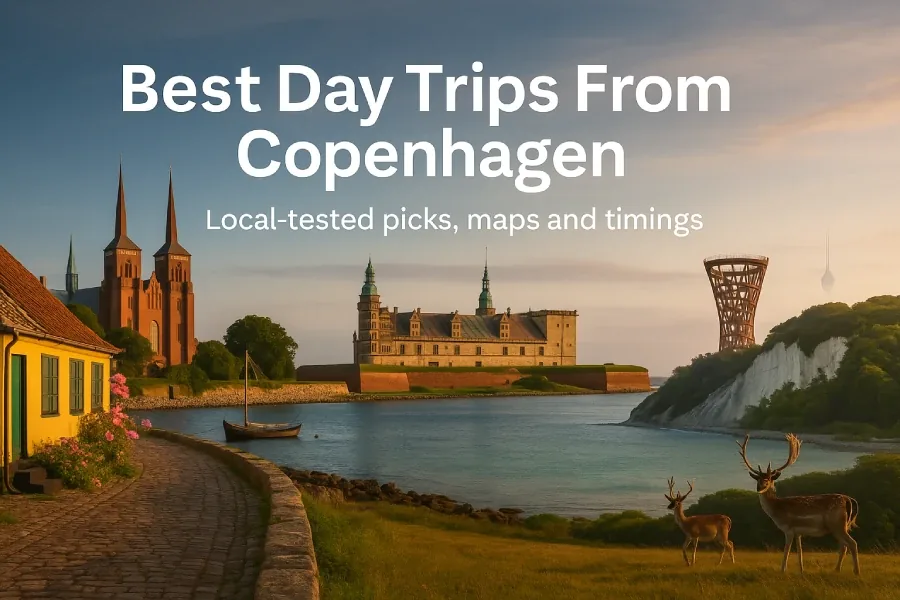
1. Why take a day trip from Copenhagen
Most visitors budget 3–4 days for Copenhagen itself and never look at a train timetable again. That's a mistake. Zealand and the wider Øresund region pack in a UNESCO castle, one of the world's best modern art museums, five preserved Viking ships, and an entire second country, all within 25 to 90 minutes of Copenhagen Central Station, most of it on the same ticket you already use for the metro.
I've done every one of these trips myself, more than once, in every season. Some are a 20-minute S-train ride you can slot in before lunch; others genuinely need a full day and, in three cases, a car or a seasonal shuttle bus rather than public transport alone. This guide ranks all 12, with the real 2026 opening hours, ticket prices and journey times for each, so you can decide in five minutes which ones are worth your time.
If you'd rather see Copenhagen itself with someone who knows it well before heading further out, that's exactly what my private walking tour covers.
The Ranking
2. The 12 best day trips from Copenhagen, ranked
Ranked on how much a first-time visitor gets out of the trip: how iconic the destination is, how easy it is to reach without a car, and real value for the ticket price. Kronborg opens the list because it delivers on all three.
Kronborg Castle, Helsingør
Shakespeare's Elsinore, and Denmark's most dramatic Renaissance castleKronborg is the castle Shakespeare used as the setting for Hamlet, and it earns the comparison: a moated Renaissance fortress on a spit of land facing Sweden across the narrowest point of the Øresund, with cannon-lined ramparts, echoing royal chambers, and dark casemates underneath where a statue of the legendary Viking Holger Danske sits waiting, according to folklore, to wake and defend Denmark. It's been a UNESCO World Heritage Site since 2000.
The direct coastal train (Kystbanen) from Copenhagen makes this the easiest "wow" day trip on this list, no transfers, no car, and you're walking through the gatehouse within an hour of leaving your hotel.
- Location: Helsingør, North Zealand
- Getting there: Direct Kystbanen train from Copenhagen H, every 15–20 min
- Journey time: About 45 min, then a 10-min walk from Helsingør station
- Opening hours: Daily 10:00–17:00, Mondays included
- Admission: 150 DKK adults (135 DKK booked online), children free
- Ticket: Standard DOT zone ticket or City Pass Large covers the train; castle entry is separate
- Official website
My tip: Book online to save 15 DKK and skip the ticket line. The M/S Maritime Museum of Denmark, built into the old dry dock right next to the castle, is worth the extra stop if you have time.
Louisiana Museum of Modern Art, Humlebæk
World-class modern art and a landmark of Danish modernist architecture, over the ØresundLouisiana is consistently ranked among the best modern art museums in the world, and the setting is half the reason: a series of low, glass-walled pavilions, designed in 1958 by Jørgen Bo and Vilhelm Wohlert and considered one of the defining works of Danish modernist architecture, strung through an old seafront park, connecting works by Giacometti, Warhol and Yayoi Kusama with a sculpture garden that looks straight across the water to Sweden. It's the single most-recommended day trip among Copenhagen locals, and for good reason.
The permanent collection alone is worth the trip, but Louisiana's temporary exhibitions are usually the real draw, check what's on before you go.
- Location: Humlebæk, North Zealand
- Getting there: Direct Kystbanen train from Copenhagen H, every 20 min
- Journey time: About 40 min, then a 10-min walk (or bus 388 direct to the door)
- Opening hours: Tue–Fri 11:00–22:00, Sat–Sun 11:00–18:00, closed Monday
- Admission: 145 DKK adults, under-18s free
- Official website
My tip: Go on a Tuesday, Thursday or Friday evening, when it's open until 22:00 and a fraction as crowded as weekend daytime. The sculpture garden at golden hour, looking toward Sweden, is one of the best views in North Zealand.
Malmö, Sweden
A whole other country, 37 minutes from Copenhagen CentralThe Øresundståg train crosses the Øresund Bridge, one of the longest combined road-and-rail bridges in Europe, and drops you in a different country in well under 40 minutes. Malmö's old town, Gamla Väster, is all cobbled lanes and pastel houses around Lilla Torg; Malmöhus Castle (1434) is the oldest preserved castle in the Nordics; and the Turning Torso, Santiago Calatrava's 190-metre twisting tower in the harbourside Västra Hamnen district, is the skyline's unmistakable landmark.
It's the one trip on this list that isn't just a different city, it's a different country, currency and language, which makes it feel like a far bigger trip than the 37-minute journey suggests.
- Location: Malmö, Skåne, Sweden
- Getting there: Öresundståg train from Copenhagen H, every 20 min
- Journey time: About 37 min, crossing the Øresund Bridge
- Documents: Bring a valid passport or EU/EEA national ID card; Sweden runs random border checks on this route
- Ticket: A separate cross-border fare, not covered by any Danish City Pass
- Highlights: Turning Torso, Lilla Torg, Malmöhus Castle
My tip: Carry your passport even though you probably won't be asked for it, checks happen at Hyllie station on the Swedish side and aren't always active. Buy your Öresundståg ticket separately in the Öresundståg or Skånetrafiken app; Copenhagen's Rejsebillet and City Pass don't cover the Swedish leg.
Roskilde Cathedral & Viking Ship Museum
Danish royalty's burial place, and five real Viking ships, 25 minutes outRoskilde does double duty as a day trip. The Cathedral, a UNESCO World Heritage Site since 1995, is the traditional burial place of Danish monarchs, brick Gothic on the outside and lined with ornate royal chapels within. A 15-minute walk away, the Viking Ship Museum houses five original Viking-age vessels recovered from the Roskilde Fjord in the 1960s, alongside a working boatyard that still builds and sails full-scale reconstructions.
It's the closest destination on this list and the one with the least room for a wasted trip: you're there and back on the same 15-minute train frequency, with UNESCO heritage and genuine Viking-age artefacts in a single afternoon.
- Location: Roskilde, Zealand
- Getting there: Direct train from Copenhagen H, every 15 min
- Journey time: About 25–27 min
- Cathedral hours: Mon–Sat 10:00–16:00 (check for services first)
- Cathedral admission: 60 DKK adults, 40 DKK students/seniors, free under 18
- Viking Ship Museum hours: 10:00–17:00 (May–mid-Oct), 10:00–16:00 (rest of year)
- Museum admission: 165 DKK adults summer / 130 DKK winter, students 105/80 DKK, family 310/240 DKK
- Official website
My tip: Do both in one visit, they're a 15-minute walk apart. Between May and September, the museum's own boatyard often has volunteers building or sailing traditional Viking-style boats, worth timing your visit around if you can.
Frederiksborg Castle, Hillerød
Denmark's largest Renaissance castle, moated and museum-filledBuilt for King Christian IV in the early 1600s across three islets in a lake, Frederiksborg is the largest Renaissance royal residence in Scandinavia and now houses the Museum of National History, room after room of portraits and interiors tracing Denmark's story from the 1500s to today. The Baroque garden behind the castle, all clipped hedges and cascading terraces, is one of the finest formal gardens in the country.
It reads as a quieter, less crowded alternative to Kronborg for anyone who wants the castle experience without the Hamlet-tour-group crowds.
- Location: Hillerød, North Zealand
- Getting there: Direct S-train from Copenhagen H, every 10–15 min
- Journey time: About 37–41 min, then a 15-min walk from Hillerød station
- Opening hours: Daily 10:00–17:00 all year, Mondays included
- Admission: 125 DKK adults, 105 DKK students and seniors 65+, free under 18
- Official website
My tip: The Baroque garden is free to enter even if you skip the museum, and it's one of the best picnic spots in Zealand, with the whole castle as a backdrop across the lake.
Dyrehaven & Bakken, Klampenborg
A free UNESCO deer park and the world's oldest amusement park, 20 minutes awayDyrehaven is an 11-square-kilometre former royal hunting forest, part of the "Par Force Hunting Landscape in North Zealand" UNESCO World Heritage listing (2015), and home to more than 2,000 free-roaming red, fallow and sika deer that wander right up to the footpaths. Right at its edge sits Bakken, founded in 1583 and generally recognised as the world's oldest operating amusement park, older than Tivoli.
Both are reachable on the same 20-minute S-train ride, and the deer park costs nothing at all, making this the best half-day trip on this list if you're travelling with kids or on a tight budget.
- Location: Klampenborg, North Zealand
- Getting there: S-train line C from Copenhagen H, every 10–20 min
- Journey time: About 20 min, then a short walk into the park
- Dyrehaven: Free entry, open year-round
- Bakken: Free entry, rides paid separately; open late March–August only
- Official website
My tip: The deer are calmest, and easiest to photograph, early morning or around dusk. Note that Bakken itself closes for the season by early autumn, but Dyrehaven and its deer are worth visiting any time of year.
Dragør Old Town
Cobbled lanes and 17th-century fishermen's cottages, right by the airportDragør's old town is one of the best-preserved historic fishing villages in Denmark, ochre-yellow and rose-red half-timbered cottages along cobbled lanes that once housed sailors and pilots for the Øresund shipping trade. It's small enough to see properly in two or three hours, and it's the only destination on this list with no train station: you get there by bus.
The lack of a train keeps the crowds down compared to almost everywhere else on this list, which is a genuine part of the appeal.
- Location: Dragør, south of Copenhagen Airport
- Getting there: Bus 350S from Nørreport/central Copenhagen, or Metro to the airport plus bus 35
- Journey time: About 35–45 min
- Ticket: Standard DOT zone ticket, no separate fare needed
My tip: Go on a weekday if you want the lanes to yourself. The harbour's smokehouses (røgerier) selling smoked herring and other fish straight from the counter are the classic lunch stop.
ARKEN Museum of Modern Art, Ishøj
A dramatic ship-shaped museum on Køge Bay, 20 minutes from the centreARKEN's building alone is worth the trip: a long, ship-like structure of concrete and steel jutting toward Køge Bay, designed to evoke a vessel run aground. Inside, the collection focuses on Danish and international modern and contemporary art. It's the shortest, cheapest art-museum trip on this list.
A dedicated public artwork, "ARKEN Walk," a 2.6km trail marked by artist Jeppe Hein's red lampposts, connects the museum to Ishøj station, so even the commute doubles as part of the experience.
- Location: Ishøj, south of Copenhagen
- Getting there: S-train line A or E from Copenhagen H to Ishøj, then bus 128 or the ARKEN Walk on foot
- Journey time: About 16–20 min by train, plus 5 min by bus or 25 min on foot
- Opening hours: Tue–Sun 10:00–17:00 (Wed until 21:00), closed Monday
- Admission: 150 DKK adults, 130 DKK students, under-18s free
- Official website
My tip: Go on a Wednesday evening for the extended hours and a much quieter museum. Walk the ARKEN Walk at least one way, Jeppe Hein's red lampposts make it a proper piece of public art, not just a route.
Odense & H.C. Andersen's House
Hans Christian Andersen's birthplace, a full but rewarding day outOdense, Denmark's third-largest city, is where Hans Christian Andersen was born in 1805, and the modern H.C. Andersen's House museum, opened in 2021 in a striking circular building, uses immersive galleries to walk you through his fairy tales and his life. It's the longest single train ride on this list, which makes it the one destination here that genuinely needs a full day rather than a half day.
This is also the only destination on this list not on Zealand: Odense sits on the island of Funen, connected by the Great Belt Bridge.
- Location: Odense, island of Funen
- Getting there: Direct InterCity train from Copenhagen H, every 30 min
- Journey time: About 1h12–1h22, tickets from 69 DKK with advance discount fares
- Museum hours: Daily 10:00–17:00 (Apr–Jun, Sep–Oct); daily 09:00–18:00 (Jul–Aug)
- Admission: 165 DKK, entry is time-slotted and must be booked in advance, including free under-18 tickets
- Official website
My tip: Book your entry slot online before you leave Copenhagen, it sells out on summer weekends. The ticket also gives free entry to Andersen's separate Childhood Home for 30 days, worth using if you have time to see both.
Stevns Klint
The 65-million-year-old line where the dinosaurs' era ends, in the cliff faceStevns Klint is a 15km limestone and chalk cliff on Zealand's southeast coast, and a UNESCO World Heritage Site since 2014 for a genuinely rare reason: a thin, dark layer of "fish clay" visible in the cliff face marks the Cretaceous–Paleogene boundary, the exact geological line left by the asteroid impact that wiped out the dinosaurs 66 million years ago. The Stevns Klint Experience visitor centre explains the science and the history in one striking building set into the landscape.
A coastal walk from the centre leads to Højerup Church, a medieval church whose choir has been crumbling toward the sea since a section collapsed in 1928, still one of the most photographed spots on this stretch of coast.
- Location: Stevns, southeast Zealand
- Getting there: Train to Køge, then Lokalbanen local train to Rødvig; or train to St. Heddinge plus a connecting bus to Højerup
- Journey time: About 80 min each way
- Opening hours: Daily 10:00–17:00 (Jun–Sep), 10:00–16:00 rest of year, closed Monday
- Admission: 150 DKK adults, 130 DKK students/seniors, free under 18
- Official website
My tip: Check Rejseplanen.dk for the exact train-to-Lokalbanen connection before you set off, the local train doesn't run as often as Copenhagen's own network, and it's an easy one to just miss.
Møns Klint & GeoCenter
128-metre white chalk cliffs over the Baltic, Denmark's most dramatic coastlineMøns Klint is a 6km run of brilliant-white chalk cliffs rising up to 128 metres straight out of the Baltic, easily the most dramatic natural scenery within reach of Copenhagen, and the GeoCenter at its base does an excellent job explaining the 70-million-year-old chalk formations and the beech forest above them. It's genuinely worth the extra effort to get here, but it takes effort: this is the first destination on this list that's meaningfully harder to reach without a car.
Public transport exists (train to Vordingborg or Stege, then local buses), but it can take 3.5 to 5 hours each way with several changes.
- Location: Møn island, southeast of Zealand
- Getting there: Best by car (about 1h40); a seasonal South Zealand Tours shuttle bus from Copenhagen also stops here
- Opening hours: Roughly 11:00–17:00 low season, extending to 10:00–18:00 in peak summer; closed late October to late March
- Admission: 155 DKK adults, 100 DKK children (3–11), free under 3, plus 45 DKK parking
- Official website
My tip: If you don't have a car, check the seasonal South Zealand Tours shuttle first, it's built specifically for visitors doing Møns Klint (and Camp Adventure) without driving, and it's far less exhausting than stringing together rural trains and buses yourself.
Camp Adventure Forest Tower
A 45-metre spiralling tower over the treetops of Gisselfeld forestThe Forest Tower is a 45-metre timber tower designed by EFFEKT Architects, reached by a gently spiralling, wheelchair- and stroller-accessible ramp that rises through the forest canopy of the Gisselfeld Kloster estate before opening onto a 360-degree view across South Zealand. Camp Adventure around its base also has Denmark's largest climbing park, with high rope courses and a 500-metre zip line.
It closes this ranking because it's genuinely the hardest destination on this list to reach without your own car: public transport is possible but takes close to two hours each way with multiple changes, and the last stretch from the highway isn't served by any bus at all.
- Location: Near Gisselfeld Kloster, South Zealand
- Getting there: Best by car (about 50–60 min); the seasonal South Zealand Tours shuttle from Copenhagen is the practical non-driving option
- Forest Tower: 200 DKK ages 7+ (185 DKK booked 72h+ ahead), 100 DKK ages 3–6, free under 3
- Climbing park (separate ticket): 375 DKK ages 15+, 275 DKK ages 7–14, 175 DKK ages 3–6
- Opening: The tower runs sunrise to sunset; the climbing park is seasonal, closed November–March
- Official website
My tip: Book online more than 72 hours ahead for the discounted rate. If you're short on time, do the Forest Tower alone, the accessible spiral ramp and the view are worth the trip even without the climbing park.
Quick Reference
3. At-a-glance comparison
A fast way to match each trip to the time and transport you actually have.
| Destination | Journey time | Best for | Price range | Needs a car? |
|---|---|---|---|---|
| Kronborg Castle | ~45 min | Castles & history | 150 DKK | No |
| Louisiana Museum | ~40 min | Art lovers | 145 DKK | No |
| Malmö, Sweden | ~37 min | A city break abroad | Train fare + spending | No |
| Roskilde | ~25 min | Vikings & royal history | 60–165 DKK | No |
| Frederiksborg Castle | ~40 min | Castles, quieter crowds | 75 DKK | No |
| Dyrehaven & Bakken | ~20 min | Families, free activities | Free (rides extra) | No |
| Dragør | ~35–45 min | A quiet historic village | Standard fare | No |
| ARKEN Museum | ~20–25 min | Art on a budget | 150 DKK | No |
| Odense | ~1h15–1h30 | A full-day literary trip | 165 DKK + train | No |
| Stevns Klint | ~80 min | Geology & coastal walks | 150 DKK | No, but slow |
| Møns Klint | ~1h40 (car) | Dramatic cliff scenery | 155 DKK + parking | Recommended |
| Camp Adventure | ~50–60 min (car) | The Forest Tower & climbing | 200–375 DKK | Recommended |
4. Getting there: trains, tickets and the Copenhagen Card
Nine of these 12 destinations run on exactly the same zone-based ticket system as the city itself. That means anything you already have for getting around Copenhagen, a standard DOT ticket bought through the Rejsebillet app, the Rejsekort app, or a City Pass, also covers the train out to Kronborg, Louisiana, Frederiksborg, Roskilde, Dyrehaven, Dragør or ARKEN. For the full breakdown of how that zone system and pricing works day-to-day in the city, see my complete Copenhagen public transport guide.
City Pass Large is the one to get for day trips
City Pass Small only covers zones 1–4 (the city plus the airport). If you're planning any of the North Zealand trips on this list, get City Pass Large instead, it covers zones 1–99, the entire capital region, and comfortably includes Kronborg, Louisiana, Frederiksborg, Roskilde and everywhere else on the standard network. Buy it through the Rejsebillet app or at any station ticket machine.
The two exceptions: Malmö and Odense
Malmö is in a different country on a different fare system entirely: buy your Öresundståg ticket separately through the Öresundståg or Skånetrafiken app, and bring a passport or EU/EEA national ID card, since Sweden runs random checks on this crossing. Odense is a long-distance InterCity route within Denmark, also priced and booked separately from the zone-based city network, with advance "Orange" fares from 69 DKK if you book ahead through DSB.
Is the Copenhagen Card worth it for day trips?
If you're planning to see several paid attractions, the Copenhagen Card Discover (from roughly 589 DKK for 24 hours up to 1,050 DKK for 72 hours) bundles free entry to 80+ attractions, including Kronborg Castle, Frederiksborg Castle, the Louisiana Museum and Roskilde Cathedral, with unlimited public transport across the same zones. For a single day trip or two, buying tickets separately is usually cheaper; if you're combining two or three castle-and-museum day trips with sightseeing in the city itself, the card can work out ahead. My public transport guide breaks down exactly when each option wins.
The three that genuinely need a car (or a seasonal shuttle)
Møns Klint, Camp Adventure and, to a lesser extent, Stevns Klint sit far enough from Copenhagen's rail network that public transport turns into a multi-hour chain of trains and rural buses. A rental car is the simplest fix for any of the three. If you don't want to drive, look up the seasonal South Zealand Tours shuttle bus, which runs from Copenhagen and stops at both Møns Klint and Camp Adventure, built specifically for visitors doing exactly this trip without a car.
Plan Your Day
5. Sample itineraries: pairing two stops in one day
Several of these destinations sit close enough together to combine, if you start early.
Castles day: Kronborg + Frederiksborg
Both are on North Zealand's rail network, roughly 40 minutes from Copenhagen in opposite directions from Hillerød. Start at Kronborg in the morning (it opens at 10:00), then backtrack via Copenhagen or connect through Hillerød in the early afternoon for Frederiksborg's Baroque garden before it closes. It's a full day, but manageable without a car.
Art day: Louisiana + a Malmö evening
Louisiana's Tuesday, Thursday and Friday evening hours (open until 22:00) make this pairing work well: spend the afternoon at the museum, take the train back into Copenhagen, and catch the evening Öresundståg to Malmö for dinner in Gamla Väster before the last train back.
Viking history: Roskilde, half-day
Roskilde is close enough that it doesn't need pairing with anything else. Cathedral in the morning, a 15-minute walk to the Viking Ship Museum, lunch by the fjord, and you're back in central Copenhagen by mid-afternoon with the rest of the day free.
South Zealand: Møns Klint + Camp Adventure
These two are the natural pair, both are hard to reach independently, both sit in South Zealand, and the seasonal South Zealand Tours shuttle bus is built around visiting them together in one trip. With a rental car, the drive between them takes well under an hour.
6. Practical tips before you go
Book ahead for time-slotted museums
H.C. Andersen's House in Odense requires a booked time slot, including for free under-18 entry, and it sells out on summer weekends. Cisternerne-style advance booking is also worth doing for Louisiana and Frederiksborg on weekends in peak season, even though it's not strictly required.
Check the season before you go
Bakken and GeoCenter Møns Klint both close for winter (Bakken from around September, the GeoCenter from late October to late March). Camp Adventure's climbing park is also seasonal. The Forest Tower, Dyrehaven, the castles and the museums stay open year-round, just with shorter winter hours.
Footwear and weather
Møns Klint and Stevns Klint both involve walking on uneven cliff paths that get slippery when wet, wear real shoes, not sandals. Danish weather changes fast regardless of season: bring a light rain layer even on a forecast-sunny day.
Use Rejseplanen.dk for anything off the main network
For Kronborg, Louisiana, Frederiksborg, Roskilde and ARKEN, turning up and checking the departure board works fine. For Stevns Klint, Møns Klint and Camp Adventure, plan your connections on Rejseplanen.dk before you leave, rural trains and buses run far less often than the city network.
A day pack beats a day bag
Several of these are genuinely full days out with a fair amount of walking, Møns Klint, Stevns Klint and Odense especially. Water, snacks and a charged phone for tickets and Rejseplanen matter more here than they do inside the city.
FAQ
7. Day trips from Copenhagen: frequently asked questions
The questions I get asked most often about getting out of the city for a day.
Kronborg Castle in Helsingør, the real-life setting for Hamlet and a UNESCO World Heritage Site, is the single most recommended day trip: it's a direct 45-minute train ride, genuinely iconic, and reasonably priced at 150 DKK. The Louisiana Museum of Modern Art and Malmö, Sweden are close behind.
No, for 9 of the 12 destinations on this list, direct trains or buses on Copenhagen's own zone-based network get you there. Only Møns Klint, Camp Adventure and, to a lesser extent, Stevns Klint are genuinely easier with a car or a seasonal shuttle bus.
Yes, Malmö is the obvious choice: a direct Öresundståg train crosses the Øresund Bridge in about 37 minutes, more often than not with a train every 20 minutes. It's a separate country with its own currency and a fare not covered by any Danish City Pass, but it's easily doable as a half-day trip, with Turning Torso, Lilla Torg and Malmöhus Castle all within walking distance of the station.
Dyrehaven and Bakken in Klampenborg: a single 20-minute train with no transfers, free entry to the deer park, and nothing to book in advance. Roskilde is a close second, 25 minutes on a train that runs every 15 minutes, with the cathedral and Viking Ship Museum a short walk from the station.
You should bring one. Sweden carries out random border checks on the Øresund crossing, mainly at Hyllie station, and EU/EEA travellers need a valid passport or national ID card. Checks aren't always active, but it's not worth risking the trip over.
City Pass Large (zones 1–99) covers the train to Kronborg, Louisiana, Frederiksborg, Roskilde, Dyrehaven, Dragør and ARKEN. City Pass Small (zones 1–4) does not reach that far. Malmö and Odense always need a separate ticket, regardless of which City Pass you have.
H.C. Andersen's House in Odense requires a booked time slot and sells out on summer weekends, book before you leave Copenhagen. Kronborg, Frederiksborg and Louisiana don't require advance booking, though buying online saves money at Kronborg and skips the queue.
Yes, several pair up well: Kronborg and Frederiksborg (both North Zealand castles), Roskilde's cathedral and Viking Ship Museum (a 15-minute walk apart), or Louisiana followed by an evening in Malmö. Møns Klint and Camp Adventure, both in South Zealand, are the natural pairing if you have a car or take the seasonal shuttle bus.
Dyrehaven and Bakken in Klampenborg: free entry to the deer park, 20 minutes from the city, and the world's oldest amusement park right next door for when the kids want rides. Camp Adventure's Forest Tower and climbing park is the pick for older kids and teens, though it's harder to reach without a car.
Dyrehaven, free entry to the deer park itself, with only a standard train ticket to pay for. Roskilde Cathedral (60 DKK) and Frederiksborg Castle (75 DKK) are the cheapest paid attractions on this list.
My Local Take
8. Final thoughts: my take
If you only remember one thing from this guide, make it this.
If you only take one day trip, make it Kronborg: it's a direct train, a genuine UNESCO castle, and it delivers exactly what people picture when they imagine a European day trip. Louisiana and Malmö are the two I'd add next, in either order, one for world-class art, one for the novelty of a second country in an afternoon.
If you're travelling with kids or on a tight schedule, Dyrehaven and Bakken need almost no planning and cost almost nothing. And if you've already done the easy trips and want something more dramatic, Møns Klint's chalk cliffs are worth renting a car for, just don't expect to reach them on a whim by train.
Whichever you pick, check the opening hours for your specific dates before you go, several of these shift substantially between summer and winter, and Bakken in particular is only open half the year.
Join the conversation
Comments
Questions, tips or corrections about this guide? Leave a comment, every comment is checked before it goes live.
Be the first to comment on this guide.
Thanks for your comment!
It's in the queue for review and will appear here once it's approved.